A Structural Disruption
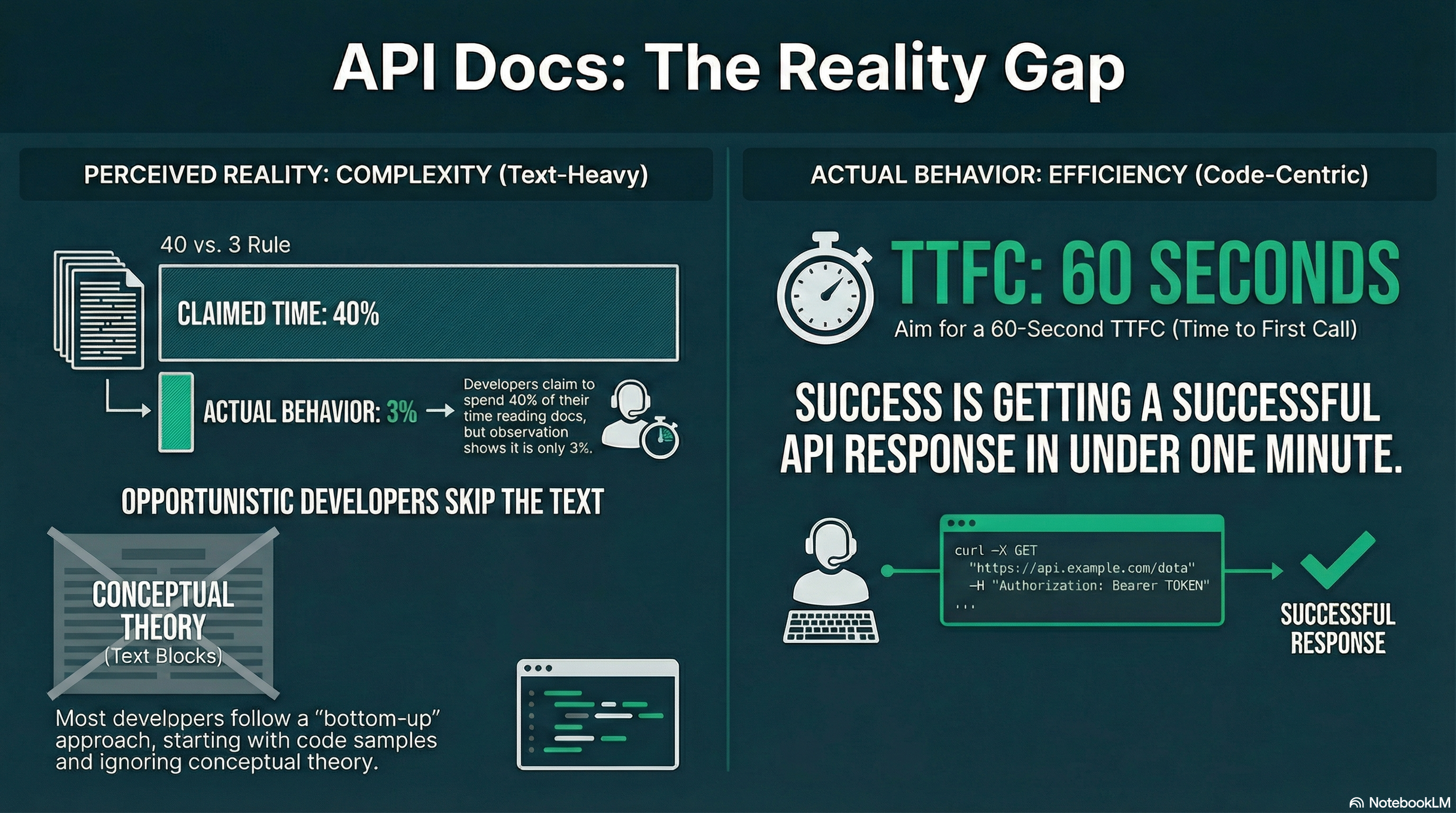
Documentation, a developer's pride and glory, yet also the bane of existence for many. We all lie to ourselves and to our managers. We claim to be students of the manual, strict readers - start to finish. We tell everyone we spend 40% of our time reading documentation, it feels responsible it sounds professional.
In reality..? Observation logs from Merseburg University say otherwise. It is actually 3%.
We don't read every single sentence, we hunt & skim. We are always on the search for the specific fragment of code that stops the bleeding and moves the ticket. Most documentation is built for a reader that doesn't exist. It is a library built for a world of students, but the trenches are full of developers looking to close their ticket and end the day. It is time we stop pretending and accept that having an in depth manual, while necessary, is not always the first answer.
The "Opportunistic" Developer vs. The Manual
Most of us developers are "opportunistic", including myself. This is not a slur, after all it is a high-speed survival strategy in the high-pressure Application Programming Interface (API) economy of today. Systematic developers work top-down, reading the theory before the practice. But when you theoretically know the theory, you rarely reread what you already know. The other majority of us work bottom-up - starting with code modification. We start by breaking things.
Many tasks require engineers to 'stitch together' functionality that existing APIs provide instead of programming functionality from scratch.
I mean how can we be blamed for that? When working with limited requirements, you'll rarely every have a perfectly planned out scope - you'll patch all the holes you never knew where there. We are not architects building from raw stone. We are assembly workers using pre-fab parts. It is efficiency, and if your documentation doesn't allow for immediate, low-friction "stitching," it is dead on arrival.
The 60-Second Success Window (TTFC)
The clock starts the moment a developer hits your landing page. You have sixty seconds. If they don't see a successful HTTP 200 OK response within that minute, they are looking at your competitor. Time to First Call (TTFC) is the only metric that matters for conversion.
Industry leaders like Stripe understand this. They win because they reduced TTFC from 14 days to 2 days. They kill the "authentication wall" by providing working test credentials immediately. Seeing success within 60 seconds is the ultimate conversion tool. It correlates directly to higher Net Promoter Scores (NPS). Success breeds loyalty. Friction breeds churn.
The "Shadow API" Compliance Time Bomb
Undocumented APIs are a massive security liability. Most organizations have 10% to 20% more active APIs than they realize. These are "Shadow APIs". They are endpoints that went live in a dev environment and stayed there. They are "zombie" vulnerabilities like Log4j, Oracle WebLogic, or Joomla CVEs waiting for a surgical strike.
They are also compliance landmines. In the past 20 years, we have seen 15 million requests-per-second Distributed Denial-of-Service (DDoS) attacks. If you don't know an endpoint exists, you cannot protect it. Under the Privacy Act and AUSTRAC regulations, the penalties are real. Serious data breaches can result in penalties up to €50 million. Most of these target data-access endpoints via Broken Object Level Authorization (BOLA).
An undocumented API is like an unlocked back door in a high-security vault. The vault is useless if the hinges are invisible to the guards. If it isn't documented, it isn't secure. Period.
Documentation as a High-Yield Asset (The 404% ROI)
Documentation is not a cost center, contrary to belief it is a high-yield asset. Research from FinancesOnline proves the logic:
Documentation management delivers a 404% ROI over five years.
It is what it is.
The Multiplier Effect is the difference between a team that builds and a team that struggles. Quality documentation leads to 59% faster innovation cycles. You reduce support volume because developers can troubleshoot themselves. You compress sales cycles because the technical answers are already there.
I've seen the simplest queries take weeks to get a response, being deemed low priority just because the knowledge silo left 2 months ago. Imagine putting your service on hold because of that alone. The teams that do not prioritise documentation are the same ones that get bitten.
The Multiplier Effect
- 42.3x multiplier for trunk-based development performance.
- 22.0x lift for Continuous Integration (CI).
- 10.4x lift for Continuous Delivery (CD).
- 66% to 70% reduction in support ticket volume.
The Invisible Readers
We aren't just writing for humans anymore. The reader is changing, 89% of us are leveraging AI to get the upper hand, faster development times, greater results. One prompt goes through thousands of hoops, trained APIs and learning on the go if you've even got a documented API.
Yet only 24% of you are actually designing for it.
That is a massive gap, a massive failure. Writing for robots feels like feeding the beast. Documentation must now serve as "context-as-a-service" for Large Language Models (LLMs). We need machine-readable standards and the Model Context Protocol (MCP). If an AI agent cannot discover, understand, and invoke your API, your product is effectively invisible to the next generation of software. If the bot can't parse your docs, the human developer never even gets the chance to see your product.
Let's face it. You'll rarely meet anyone that reads the yellow pages, so why would you only list yourself there?
So... What now?
Documentation is the product interface. It is the first professional handshake between a provider and a client. It is not a supplementary manual but a roadmap for interaction.
Your team can greatly benefit from well documented APIs (Postman Collections, Swagger, OpenAPI). Just stick with these rules:
- Keep it short, include the details when necessary
- Eliminate knowledge silos, get your team used to referring to the docs
- Make sure your API documentation is accessible as the API itself
- Get into the routine of documenting your endpoints
If the documentation fails, the product fails. It is time to treat it with the same engineering rigor we apply to the code itself.
Would you risk failing a feasibility test over a mis-documented endpoint?